
 Image 1 of 4
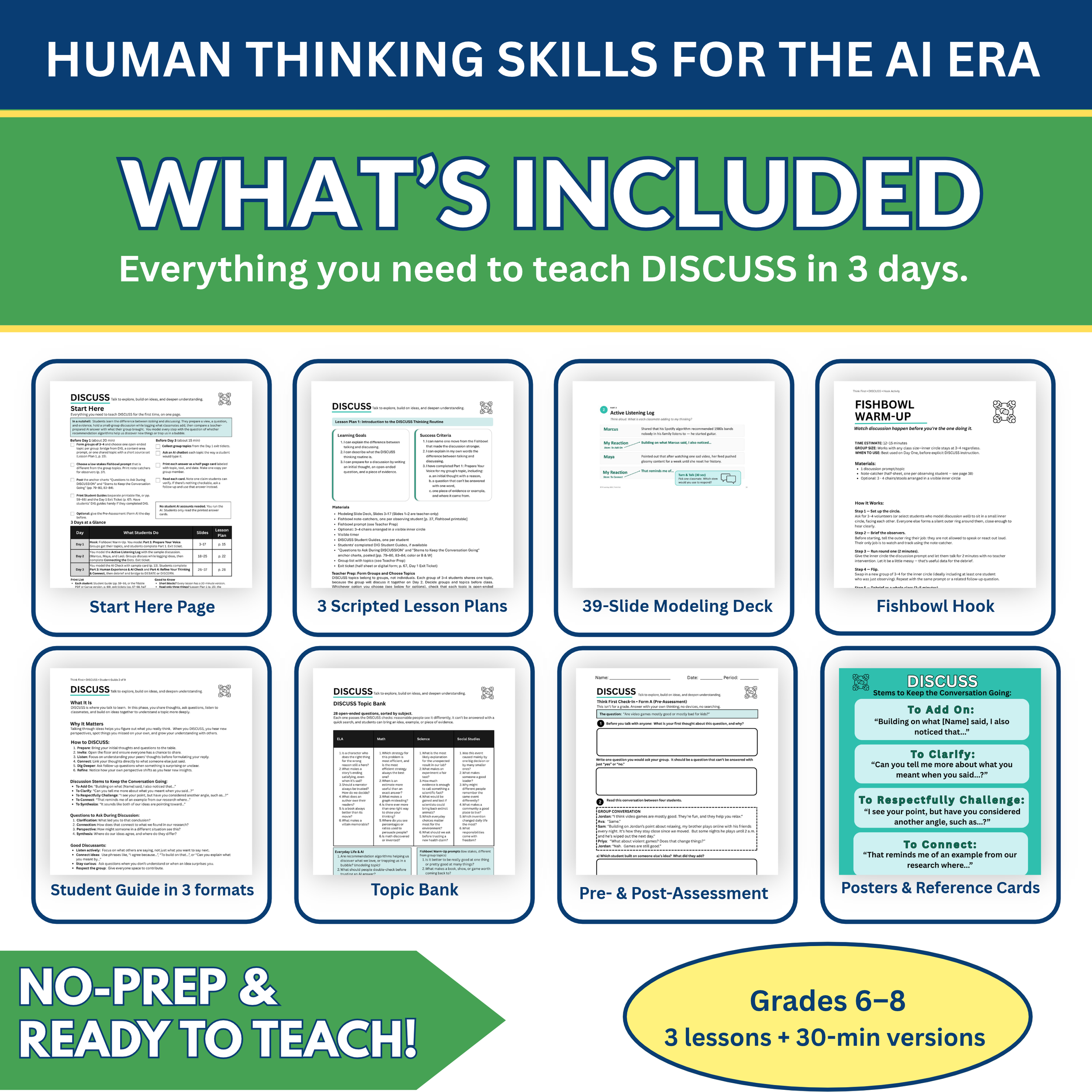 Image 2 of 4
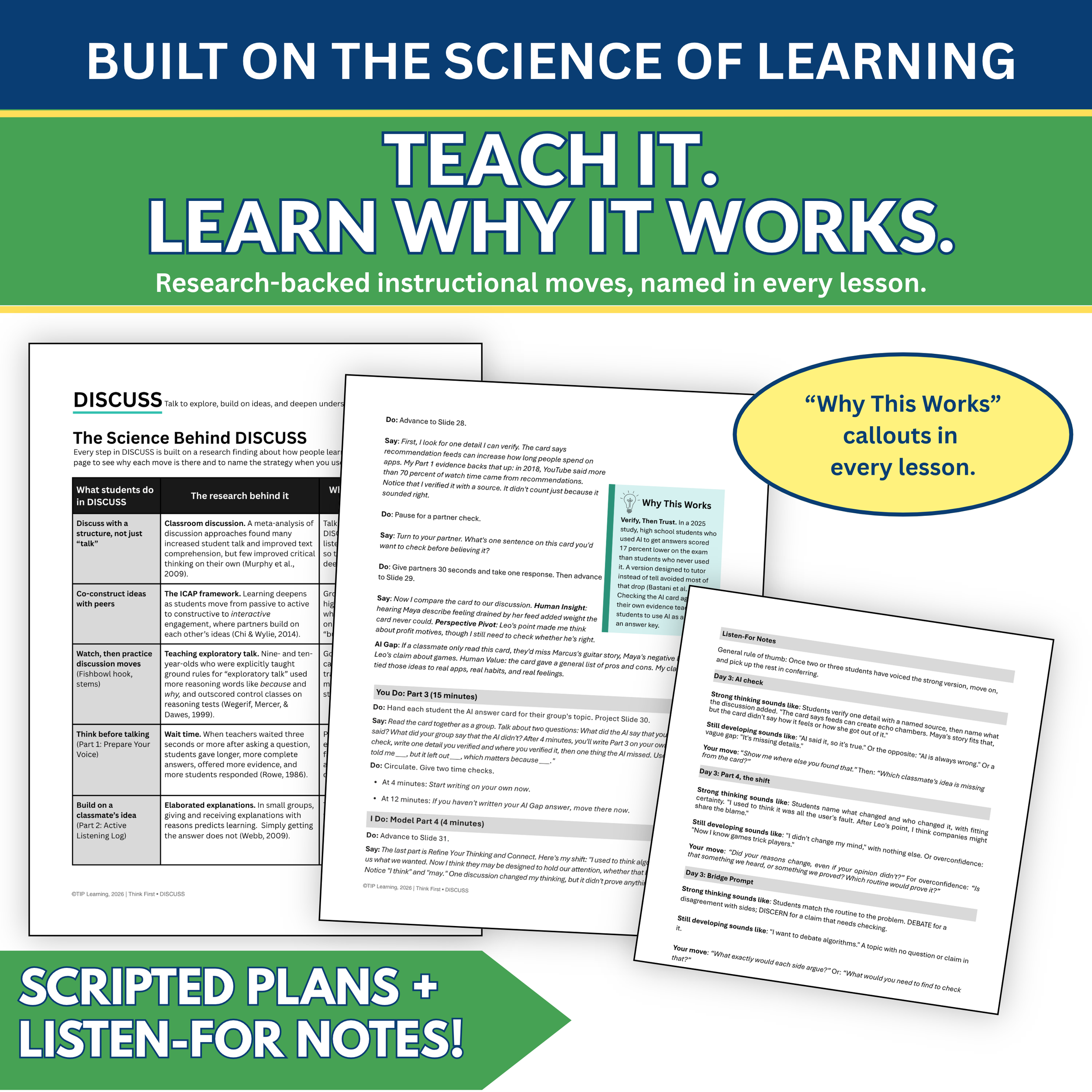 Image 3 of 4
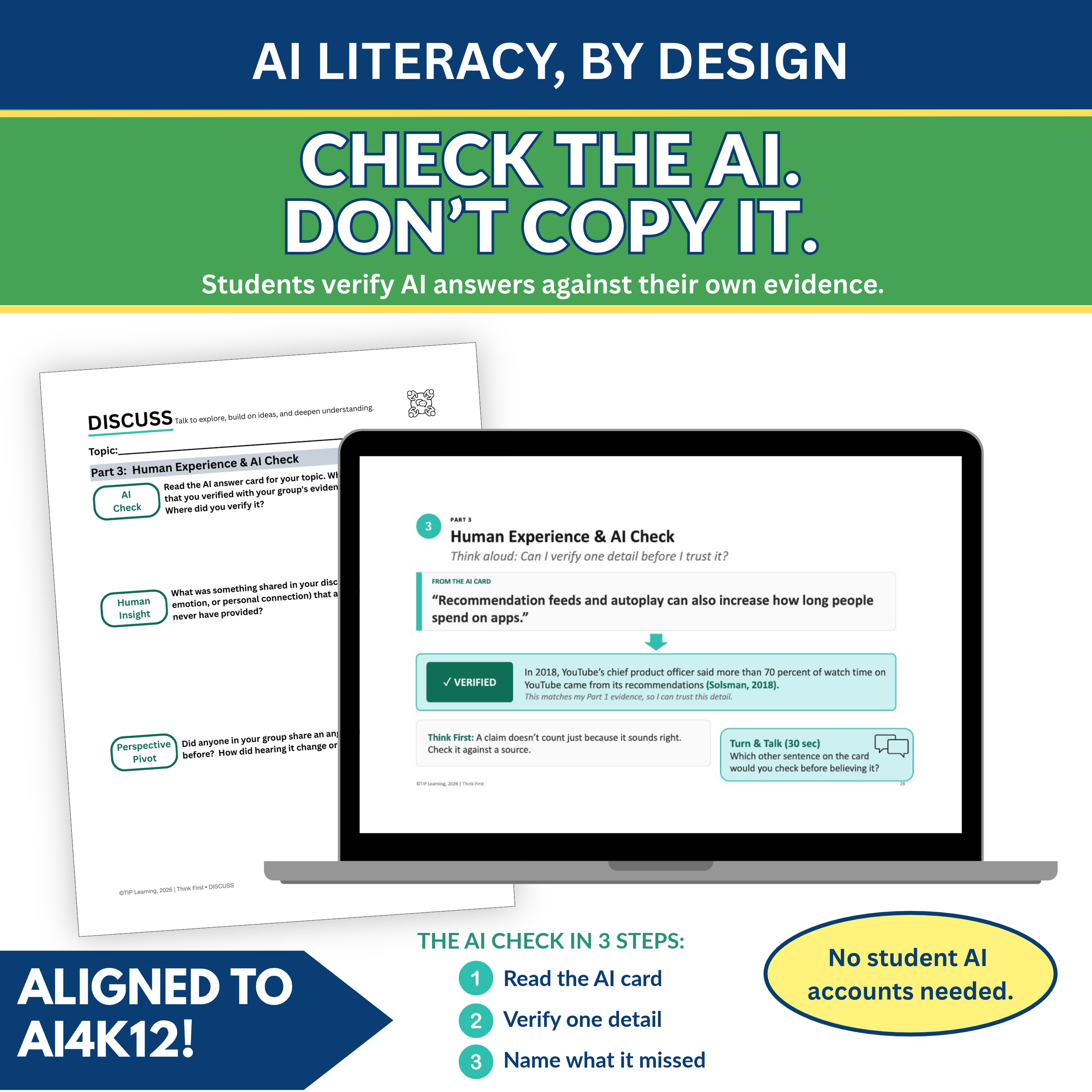 Image 4 of 4
Artificial Intelligence and Discussion Skills All Subject Areas for 6th 7th 8th
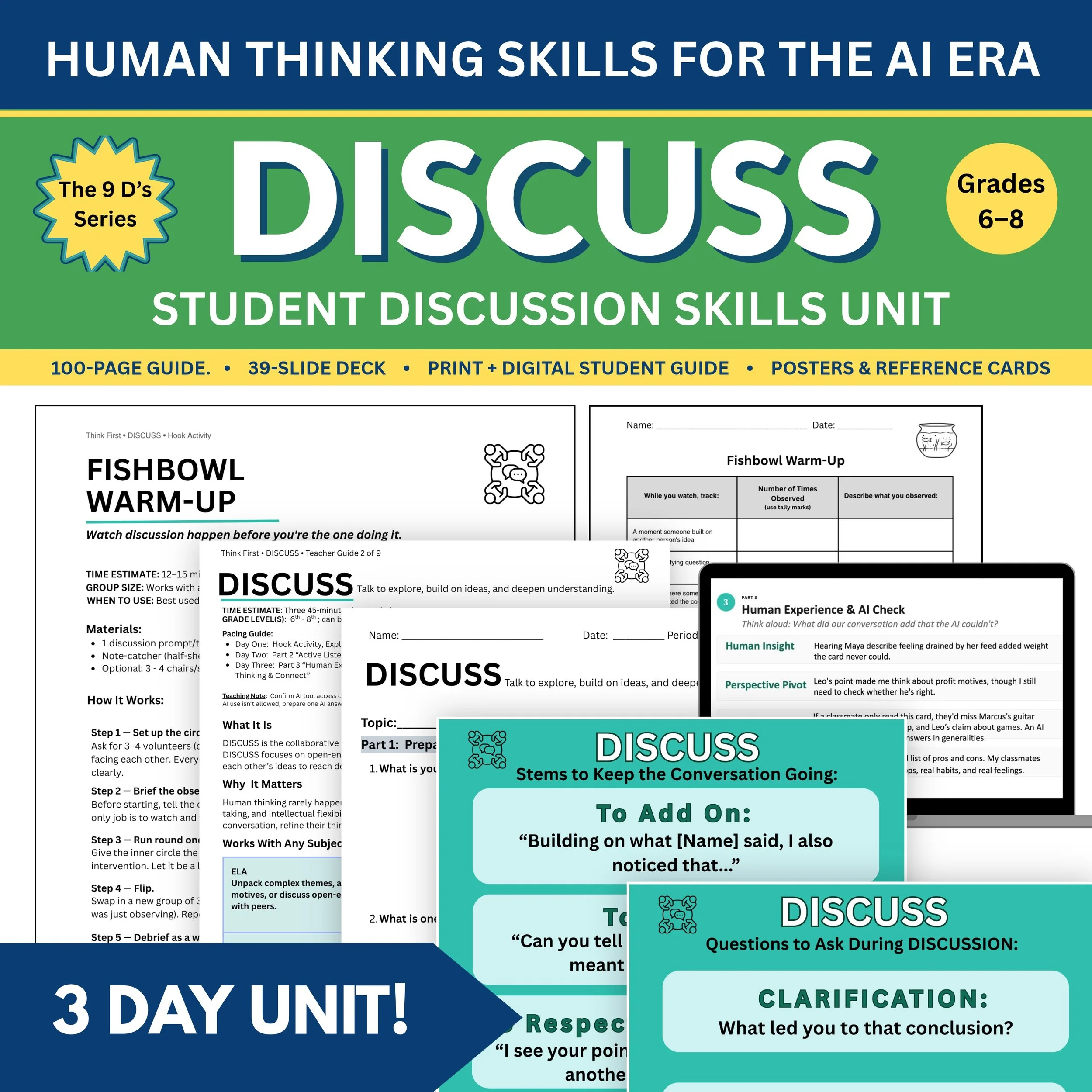
Equip your 6th, 7th, and 8th graders to think out loud, together, in an AI-driven world.
DISCUSS is a complete, ready-to-teach routine that builds active listening, collaborative reasoning, and AI literacy. It’s aligned to speaking and listening standards and to the AI4K12 Five Big Ideas in AI.
AI can produce an answer in two seconds. Working through a question out loud with real people is a skill students have to be taught on purpose. DISCUSS teaches it explicitly over three class periods: you model each step, the class practices together, and students apply the routine in their own small-group discussions.
What Makes This Different
Most discussion resources stop at sentence stems. DISCUSS is a gradual-release lesson sequence with a full think-aloud model, so students see and hear what good discussion sounds like before they’re asked to do it.
It includes a Human Experience & AI Check. Students read an AI-generated answer about their own topic, verify one detail against their evidence, and name what their classmates’ stories and perspectives added that the AI missed. You prepare the AI answer cards ahead of time, so students never need their own AI accounts.
Every lesson is built on the science of learning. “Why This Works” callouts in each lesson plan name the research-backed strategy behind each step and cite the research, so you learn the instructional science while you teach. A Science Behind DISCUSS section and a full References page are included.
Each round of the routine ends with a Bridge: students identify a disagreement worth DEBATING or a claim worth DISCERNING, which sets up the next routines in the series.
DISCUSS is Routine 2 in the Think First: 9 D’s of Human Thinking series (Dig, Discuss, Debate, Discern, Dialogue, Dream, Decide, Design, Debrief), a framework for building human thinking skills before students rely on AI. It also works completely on its own.
What’s Included:
✅ 100-Page Instructional Guide. A one-page Start Here quick-launch, three scripted lesson plans with “Do/Say” teacher moves, “Why This Works” research callouts, Listen-For notes describing what strong and still-developing student thinking sounds like, differentiation for each day, and a 30-minute version of every lesson.
✅ 39-Slide Think-Aloud Modeling Deck (PowerPoint). Models every part of the routine on a sample topic: “Are recommendation algorithms helping us discover what we love, or trapping us in a bubble?” It includes “Today in DISCUSS” goal slides, Turn & Talk prompts, a step-by-step AI-verification model, and optional sentence-frame, word-bank, and challenge slides. Full teacher script in the speaker notes, with two customizable slides (Fishbowl prompt and Debrief hand-off).
✅ Student Guide in Three Formats. Printable PDF, fillable PDF (students type the topic once and it fills in on every page), and a Canva template. All three follow the same four parts: Prepare Your Voice → Active Listening Log → Human Experience & AI Check → Refine Your Thinking & Connect.
✅ Modeling Exemplar, Rubric & Sample AI Card. A completed sample response, a four-row Emerging/Proficient/Advanced rubric that assesses the quality of students’ reasoning (not whether you agree with their conclusions), and a sample AI answer card with step-by-step directions for making cards for your class’s topics.
✅ Pre-/Post-Assessment. Two parallel forms on different topics, a scoring guide, an answer key, and a Class Growth Tracker, giving you simple evidence of growth for PLCs, evaluations, or your principal.
✅ Fishbowl Warm-Up Hook. A low-prep opener where students watch a discussion before joining one, with debrief questions and a two-per-page note-catcher.
✅ Day 1 & Day 2 Exit Tickets. Quick checks that show you who’s ready for the next lesson.
✅ 10-Page Poster & Reference Card Set. “Questions to Ask During Discussion” and “Stems to Keep the Conversation Going” anchor charts in full color and ink-saving black & white, plus matching reference cards for each group.
✅ Topic Bank & Reuse Guide. 28 open-ended discussion questions across ELA, math, science, and social studies, plus everyday-life, AI, and Fishbowl prompts, with guidance for using DISCUSS again on new topics all year.
✅ Word Bank, Printable Talking Chips & AI4K12 Alignment. Academic vocabulary for discussion, cut-apart talking chips for groups where one voice dominates, and an alignment chart showing where DISCUSS meets the AI4K12 Five Big Ideas.
✅ Built-In Differentiation. Sentence frames, word banks, and structured roles (Speaker, Questioner, Note-Taker) for emerging learners, plus extension challenges for advanced learners.
Standards Addressed
SL.6.1 / SL.7.1 / SL.8.1
W.6.4 / W.7.4 / W.8.4
ISTE 1.3b / 1.3d
AI4K12 Five Big Ideas in AI
Perfect For
Teaching real active listening, not just taking turns
Building AI literacy without putting students on AI tools
Any subject: the Topic Bank covers ELA, math, science, and social studies, and the student guide works with any open-ended question
Laying a collaborative foundation before DEBATE
Reusing all year: once students learn the routine, they can use the student guide for new topics in any unit
Grade Level: Grades 6–8 (adaptable for grades 4–5)
Time: Three 45-minute class periods (30-minute versions included)
Prep: About 15 minutes before Day 3 to print the AI answer cards. Everything else is print-and-teach.
Give your students the tools to think with each other. Grab DISCUSS today, and explore the full Think First: 9 D’s series for a complete framework of human thinking instruction.