
 Image 1 of 1
AI Research Skills & Literacy Guide for 6th 7th 8th Grades | 9D's: DIG
Think First, THEN AI.
A 9-D Framework for Teaching Middle Schoolers to Think Like Humans, Before They Ask a Machine.
Your students already have AI in their pocket. What they don't yet have is the habit of thinking before they reach for it.
DIG is the first guide in the Think First series, a set of nine instructional tools that build students' independent thinking skills first. Then each guide shows students how to use AI to check, deepen, or stretch that thinking, not replace it.
This isn't an anti-AI resource. It's a pro-human-thinking-first resource.
What is DIG?
DIG is the research and information-gathering skill: the ability to find things out and check them before jumping to conclusions or outsourcing the thinking altogether.
Students learn to:
Reflect on what they already know (and where that knowledge came from) before researching
Find and log multiple types of sources, and tell primary sources from secondary ones
Evaluate sources with four questions: Origin, Type, Reliability, and Completeness
Check an AI answer against real sources and notice what it got right, what it got wrong, and what it left out
Recognize DIG as a distinct, nameable mode of thinking they can use anytime, in any class
Hooked from Minute One
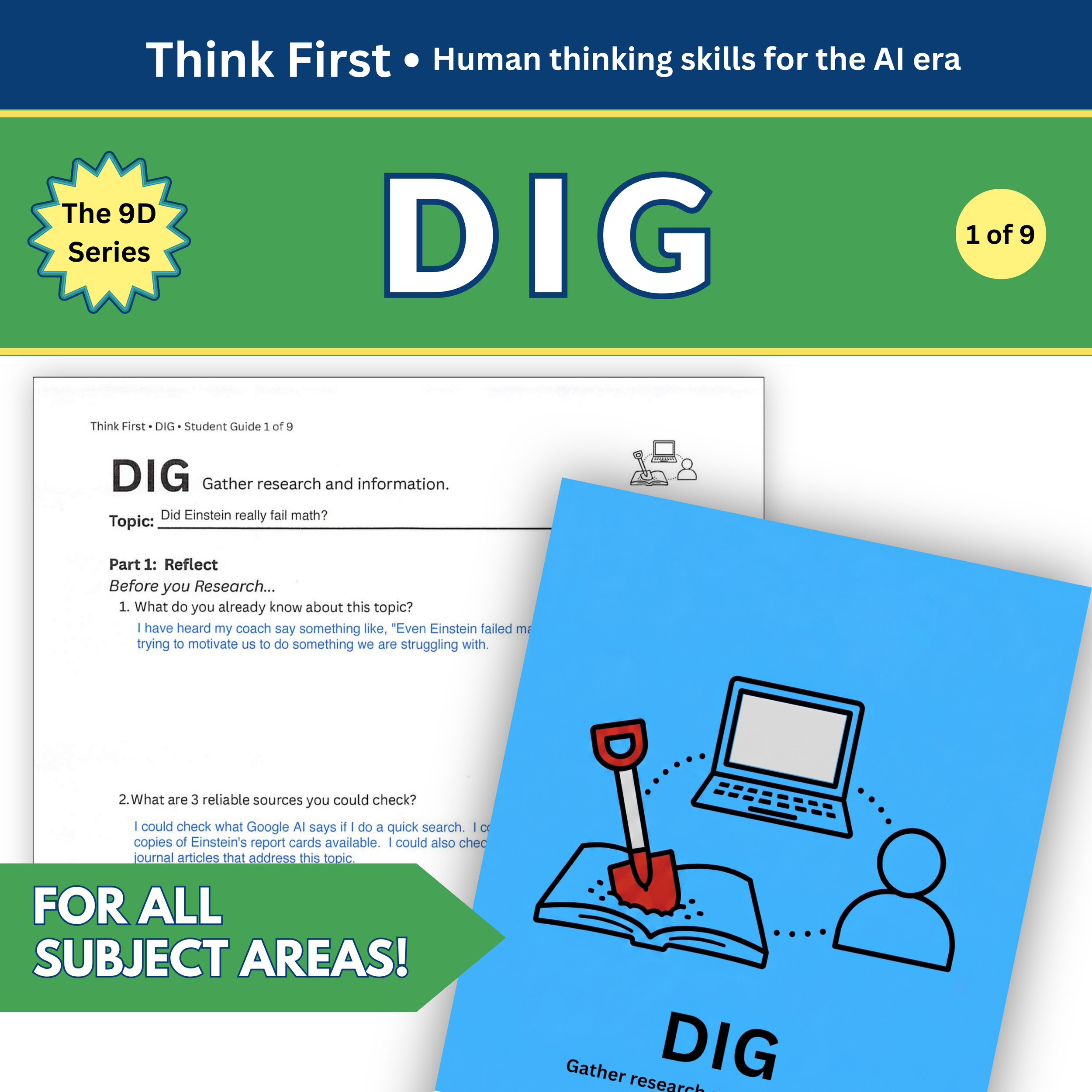
Lesson 1 opens with a True-or-False warm-up (Tic-Tac-Toe or Bingo) built on claims most people believe, and many aren't true. Students discover firsthand that feeling sure isn't the same as having evidence. From there, you model the full routine with a claim that has been printed on posters and mugs for decades: Did Albert Einstein really fail math? Students follow the trail from a motivational poster, to a biographer's article, to Einstein's actual 1896 report card, and learn why the myth was so easy to believe.
What's Included:
3-Day Scripted Lesson Plans: three 45-minute lessons with 30-minute versions, word-for-word teacher talk, gradual release (I do, We do, You do), differentiation, and "Listen-For" notes that show you what strong and still-developing thinking sounds like
Teacher Guide: pacing, a complete modeling exemplar, prompt bank, and a four-row rubric
Hook Activity: True-or-False warm-up with a claim bank, answer key, and two game-board options (color and ink-saving versions)
Think-Aloud Modeling Deck: slides with speaker notes that walk your class through the Einstein example step by step, including filled-in note-catchers
Student Guide (print and digital slide formats): Reflect, Gather, AI Credibility Check, and Synthesize & Connect
Exit Tickets: half-sheet checks for Days 1 and 2
Posters, Anchor Charts, and Reference Cards: including "Questions to Ask Every Source" and sentence stems for sharing research
Where AI Fits In
On Day 3, after students have gathered their own sources, they complete a structured AI Credibility Check. Each student compares an AI-generated answer about their topic against the sources they found. They name one detail they verified and one thing the AI missed or got wrong. Because many middle schoolers are below AI tools' age minimums, the lesson plans show you how to prepare the AI answers in advance. That way every student takes part, with or without their own AI access.
This sequencing teaches responsible, intentional AI use, which departments and administrators increasingly want to see evidence of.
Built for Every Subject, Every Classroom
DIG isn't tied to one topic or unit. The lesson plans include sample research claims for ELA, Science, Social Studies, and Math, or students can choose their own. Use it for:
ELA: researching an author, historical context, or a literary claim
Social Studies: investigating a historical claim or current event
Science: gathering background before a lab or inquiry project
Math: checking a popular claim about numbers or patterns in the real world
Aligned to CCSS: W.6.8 / W.7.8 / W.8.8, RI.6.1 / RI.7.1 / RI.8.1, SL.6.1 / SL.7.1 / SL.8.1
Why Teachers Love the Think First Series
✔ Low-prep and ready to teach, with fully scripted lessons
✔ Cross-curricular: works in any subject area
✔ Builds a reusable, transferable thinking skill, not a one-time worksheet
✔ Print and digital student formats
✔ Addresses AI thoughtfully, without banning it or ignoring it
✔ Part of a growing 9-guide series
DIG is Guide 1 of 9 in the Think First series. Look for Debate, Discuss, Discern, Dialogue, Dream, Decide, Design, and Debrief, coming soon.
Think First, THEN AI.
A 9-D Framework for Teaching Middle Schoolers to Think Like Humans, Before They Ask a Machine.
Your students already have AI in their pocket. What they don't yet have is the habit of thinking before they reach for it.
DIG is the first guide in the Think First series, a set of nine instructional tools that build students' independent thinking skills first. Then each guide shows students how to use AI to check, deepen, or stretch that thinking, not replace it.
This isn't an anti-AI resource. It's a pro-human-thinking-first resource.
What is DIG?
DIG is the research and information-gathering skill: the ability to find things out and check them before jumping to conclusions or outsourcing the thinking altogether.
Students learn to:
Reflect on what they already know (and where that knowledge came from) before researching
Find and log multiple types of sources, and tell primary sources from secondary ones
Evaluate sources with four questions: Origin, Type, Reliability, and Completeness
Check an AI answer against real sources and notice what it got right, what it got wrong, and what it left out
Recognize DIG as a distinct, nameable mode of thinking they can use anytime, in any class
Hooked from Minute One
Lesson 1 opens with a True-or-False warm-up (Tic-Tac-Toe or Bingo) built on claims most people believe, and many aren't true. Students discover firsthand that feeling sure isn't the same as having evidence. From there, you model the full routine with a claim that has been printed on posters and mugs for decades: Did Albert Einstein really fail math? Students follow the trail from a motivational poster, to a biographer's article, to Einstein's actual 1896 report card, and learn why the myth was so easy to believe.
What's Included:
3-Day Scripted Lesson Plans: three 45-minute lessons with 30-minute versions, word-for-word teacher talk, gradual release (I do, We do, You do), differentiation, and "Listen-For" notes that show you what strong and still-developing thinking sounds like
Teacher Guide: pacing, a complete modeling exemplar, prompt bank, and a four-row rubric
Hook Activity: True-or-False warm-up with a claim bank, answer key, and two game-board options (color and ink-saving versions)
Think-Aloud Modeling Deck: slides with speaker notes that walk your class through the Einstein example step by step, including filled-in note-catchers
Student Guide (print and digital slide formats): Reflect, Gather, AI Credibility Check, and Synthesize & Connect
Exit Tickets: half-sheet checks for Days 1 and 2
Posters, Anchor Charts, and Reference Cards: including "Questions to Ask Every Source" and sentence stems for sharing research
Where AI Fits In
On Day 3, after students have gathered their own sources, they complete a structured AI Credibility Check. Each student compares an AI-generated answer about their topic against the sources they found. They name one detail they verified and one thing the AI missed or got wrong. Because many middle schoolers are below AI tools' age minimums, the lesson plans show you how to prepare the AI answers in advance. That way every student takes part, with or without their own AI access.
This sequencing teaches responsible, intentional AI use, which departments and administrators increasingly want to see evidence of.
Built for Every Subject, Every Classroom
DIG isn't tied to one topic or unit. The lesson plans include sample research claims for ELA, Science, Social Studies, and Math, or students can choose their own. Use it for:
ELA: researching an author, historical context, or a literary claim
Social Studies: investigating a historical claim or current event
Science: gathering background before a lab or inquiry project
Math: checking a popular claim about numbers or patterns in the real world
Aligned to CCSS: W.6.8 / W.7.8 / W.8.8, RI.6.1 / RI.7.1 / RI.8.1, SL.6.1 / SL.7.1 / SL.8.1
Why Teachers Love the Think First Series
✔ Low-prep and ready to teach, with fully scripted lessons
✔ Cross-curricular: works in any subject area
✔ Builds a reusable, transferable thinking skill, not a one-time worksheet
✔ Print and digital student formats
✔ Addresses AI thoughtfully, without banning it or ignoring it
✔ Part of a growing 9-guide series
DIG is Guide 1 of 9 in the Think First series. Look for Debate, Discuss, Discern, Dialogue, Dream, Decide, Design, and Debrief, coming soon.