These tech-free activities can help keep young children occupied indoors on days when it’s not ideal to be outside. They tend to work best when saved for rainy days or other indoor times, so they still feel new and exciting when you bring them out.
Want a Ready-to-Go Rainy Day Kit?
If you'd rather skip the planning and prep, TIP Learning Rainy Day Kits include a variety of fun, age-appropriate activities that are ready to use whenever you're stuck indoors. Just grab a kit and enjoy more quality time together—no last-minute scrambling required. The kits also make great gifts for friends, cousins, nieces, nephews, and grandchildren.
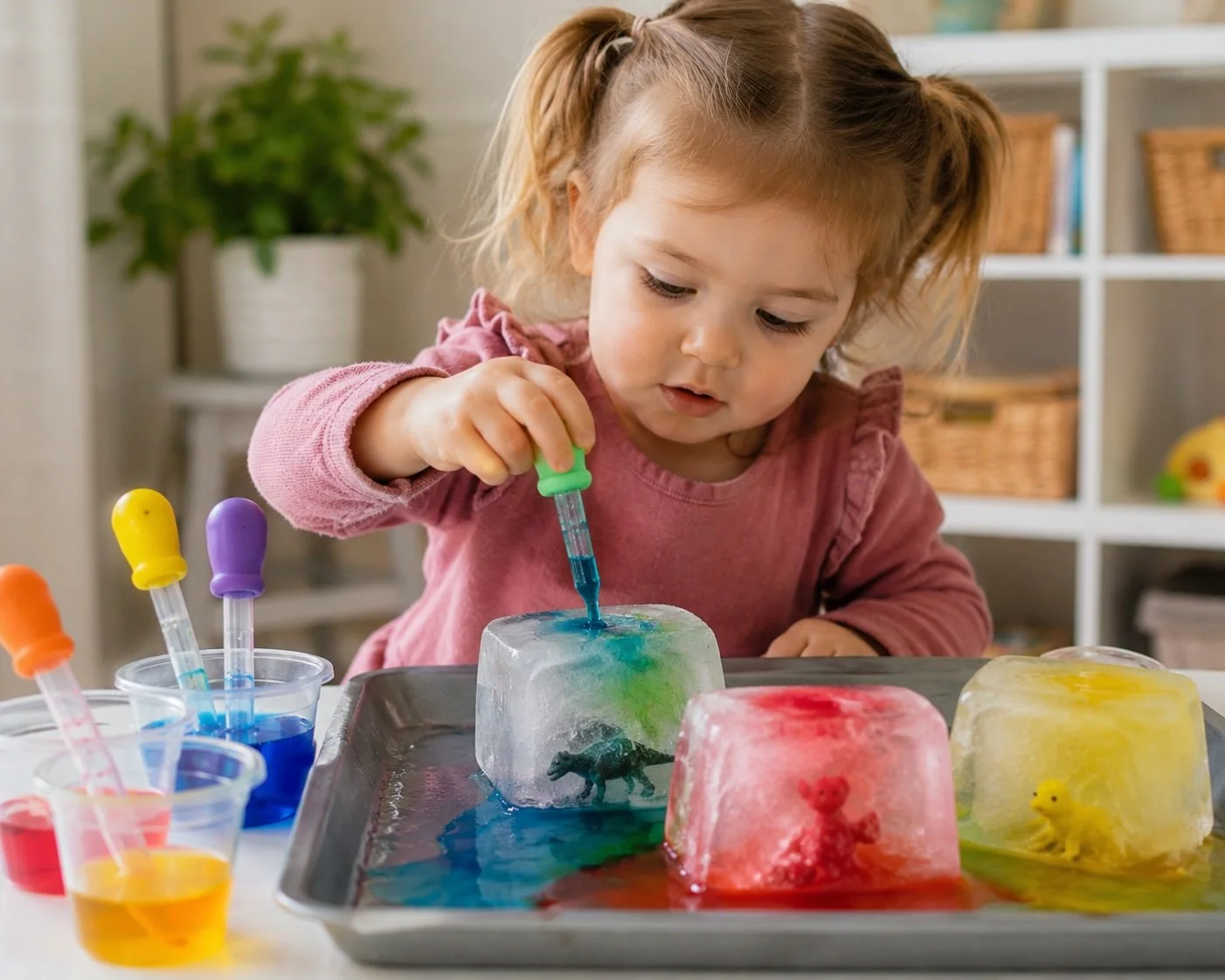
Colored Water on Ice — Let your child drip, pour, or brush colored water onto a large piece of ice and watch what happens. This simple sensory activity encourages exploration of color and temperature while supporting emerging fine motor skills and an early understanding of cause and effect.
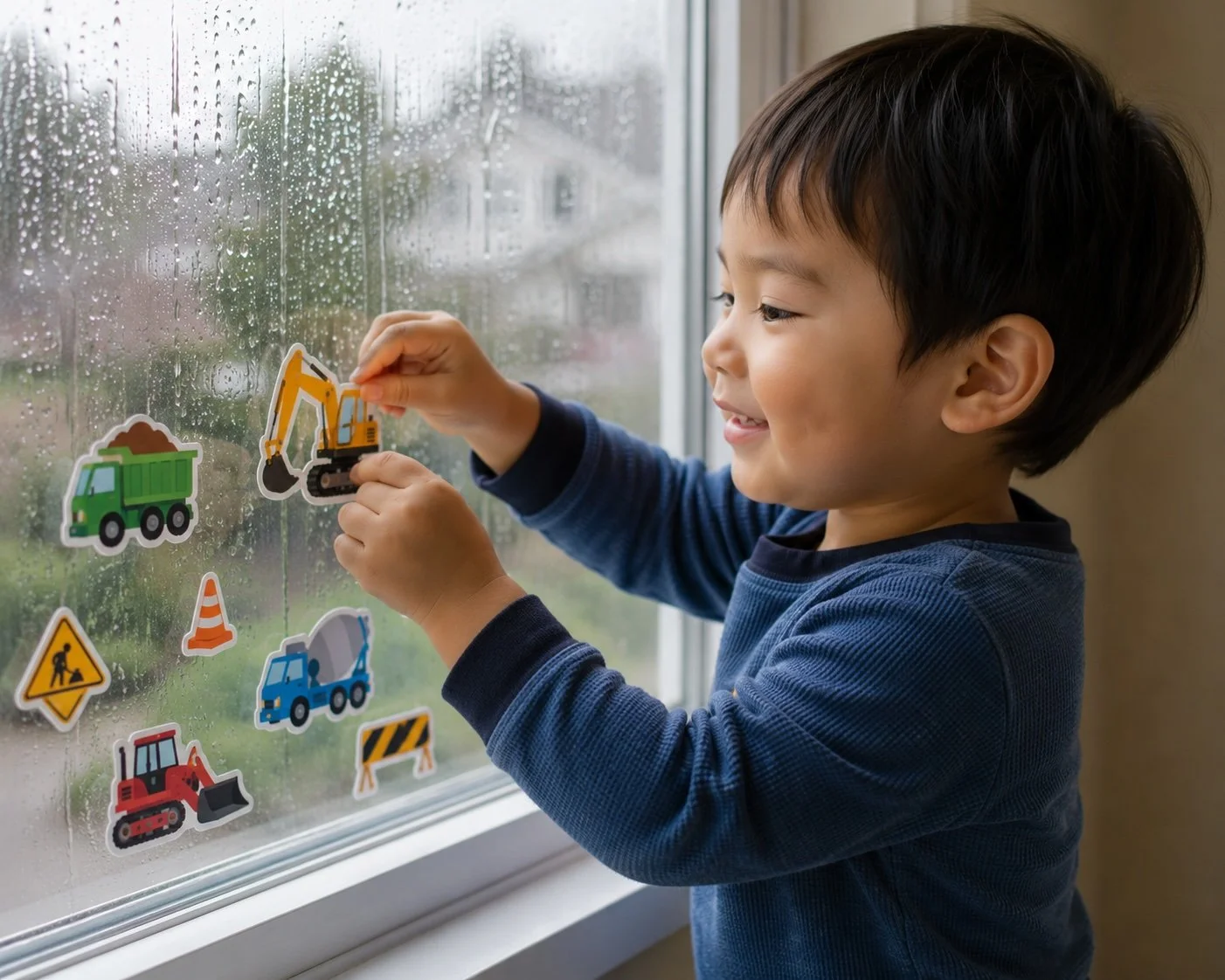
Window Stickers — Let your child place, remove, and rearrange reusable stickers or window clings on a window or other smooth surface. Peeling and placing the stickers supports emerging fine motor skills and hand-eye coordination while encouraging simple, independent exploration.
Sensory Bins — Fill a container with age-appropriate materials for your child to touch, scoop, pour, and explore. Sensory play supports fine motor development, concentration, and early problem-solving while giving toddlers opportunities to learn through hands-on exploration.
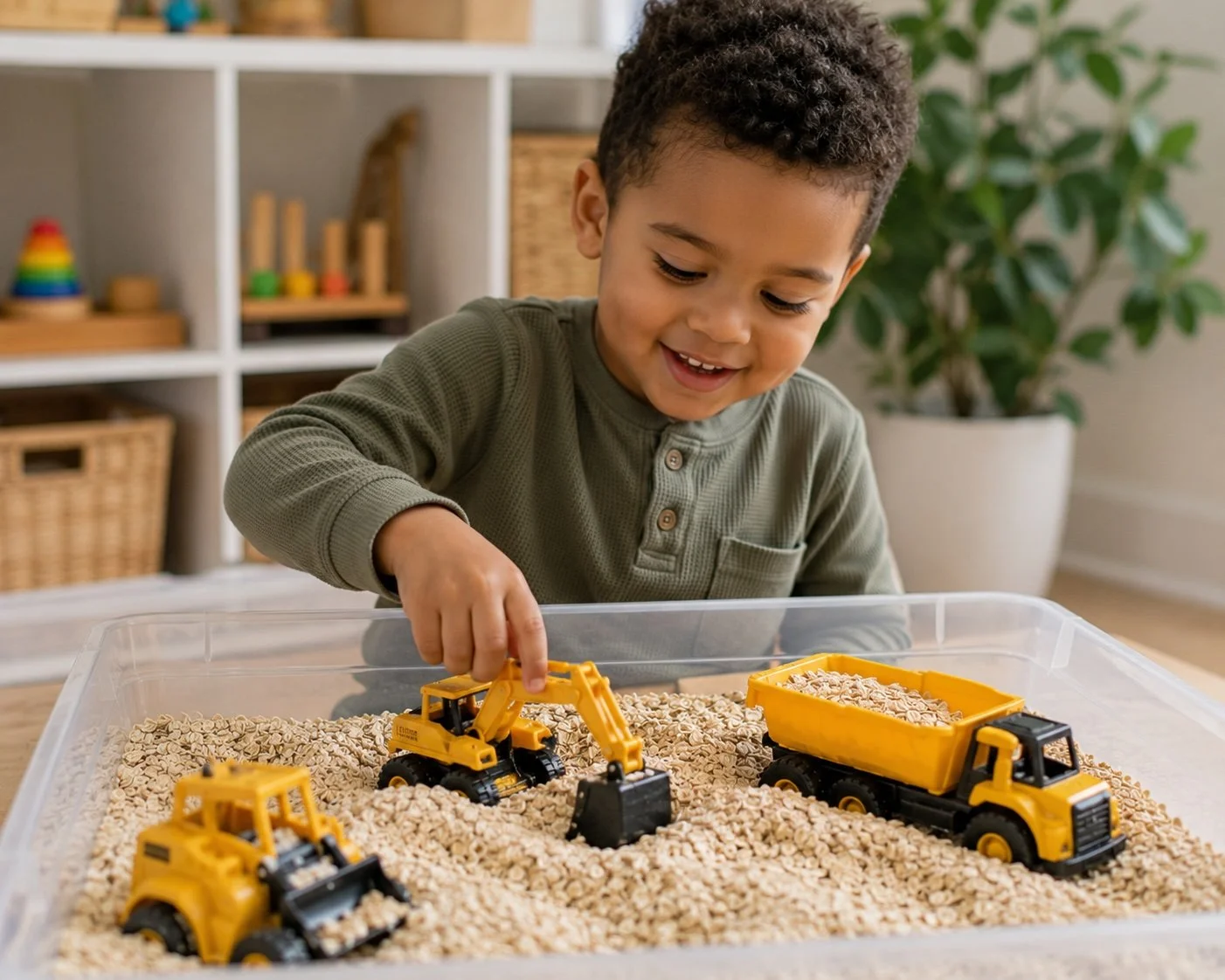
Construction site — Create a pretend construction site using kinetic sand, oatmeal, or dried beans as the “dirt,” along with toy construction vehicles and tools. Scooping, digging, filling, and dumping support fine motor skills and hand-eye coordination while introducing simple pretend play and cause and effect. (Note: Always supervise young children during sensory play and choose materials that are appropriate for your child’s age and developmental stage.)
Duck Wash— Set up a small container of water and invite your child to wash toy ducks using a sponge, cloth, or small brush. Squeezing, scrubbing, and rinsing build fine motor skills and coordination while encouraging pretend play and practice with familiar everyday routines.
Nature Sort — Gather child-safe natural items and invite your child to explore and sort them by type, size, color, or texture. Sorting helps toddlers notice similarities and differences while supporting early math skills, vocabulary development, and problem-solving.
Here Fishy, Fishy Game — Invite your child to catch, collect, or match colorful fish during a playful fishing activity. Reaching for and picking up the fish supports hand-eye coordination and fine motor skills while introducing early concepts such as colors, matching, counting, and turn-taking.
Where’s Bear? Game— Hide a toy bear and encourage your child to find it using simple clues or by searching around the room. This playful hide-and-find game supports memory, problem-solving, listening skills, and an understanding that objects still exist even when they cannot be seen. The link includes a pre-packaged option, but any ‘ol bear or stuffy will do.
Duck, Duck Dance Game — Encourage your child to move, dance, and follow simple actions along with a playful duck-themed game. Dancing supports gross motor development, balance, coordination, body awareness, and the ability to listen and respond to simple directions.
Toddler Scavenger Hunt — At Home— Help your child search around the house for familiar objects, colors, or pictures. Scavenger hunts build vocabulary, observation skills, and early problem-solving while encouraging toddlers to move, explore, and follow simple directions. The linked version is designed to advance children’s early literacy, mathematics, and reasoning skills.
Toddler Scavenger Hunt — At Home (Spanish edition) — Search around the house for familiar objects, colors, or pictures using Spanish words and simple directions. This playful activity supports observation and problem-solving skills while introducing or reinforcing Spanish vocabulary through movement and real-world connections.
Colored Water on Ice — Let your child drip, pour, or brush colored water onto a large piece of ice and experiment with what happens as the colors mix and the ice melts. This hands-on activity encourages creativity and experimentation while supporting fine motor skills, color mixing, and early scientific thinking.
Window Stickers — Let your child place, remove, and rearrange reusable stickers or window clings to create pictures, patterns, or scenes. Peeling and positioning the stickers strengthens fine motor skills and hand-eye coordination while encouraging creativity, planning, and storytelling.
Sensory Bins — Fill a container with age-appropriate materials for your child to scoop, pour, sort, count, and explore. Sensory play supports fine motor development and concentration while encouraging problem-solving, early math concepts, and open-ended imaginative play. Possibilities include:
Construction site — Create a pretend construction site using kinetic sand, rice, or dried beans as the “dirt,” along with toy construction vehicles and tools. Digging, scooping, transporting, and building strengthen fine motor skills and hand-eye coordination while encouraging planning, problem-solving, and more complex pretend play. (Note: Always supervise young children during sensory play and choose materials that are appropriate for your child’s age and developmental stage.)
Baking Bin — Set up a pretend baking station with child-safe tools, bowls, measuring cups, and materials for scooping, pouring, mixing, and creating. Pretend baking supports fine motor skills, early math concepts, sequencing, and imaginative play while giving children a chance to practice familiar real-life routines.
Garden — Create a pretend garden where your child can plant, dig, water, and care for flowers or vegetables. Gardening play supports fine motor skills, sequencing, and an understanding of how things grow while encouraging responsibility, creativity, and imaginative play.
Baby Doll Bath Time — Set up a small bath for a baby doll and invite your child to wash, rinse, dry, and care for the doll. This pretend-play activity strengthens fine motor skills and sequencing while encouraging empathy, nurturing behaviors, and practice with familiar daily routines.
Melissa and Doug Fishing Puzzle — Use the magnetic fishing rod to catch and place the puzzle pieces. This activity strengthens hand-eye coordination, fine motor control, and visual-spatial skills while encouraging concentration, problem-solving, and persistence.
Play-Doh Barber Shop — Use Play-Doh and pretend barber tools to create, cut, trim, and style different hairstyles. Squeezing and manipulating the dough strengthens hand muscles and fine motor skills while encouraging creativity, pretend play, and imaginative storytelling.
Scribble Scrubbies — Color and decorate the washable figures, then scrub them clean and start again. This reusable activity supports fine motor skills, creativity, and imaginative play while helping children practice planning, experimentation, and flexible thinking.
Preschool Scavenger Hunt — At Home — Encourage your child to search around the house for familiar objects, colors, shapes, or other clues. Scavenger hunts build observation skills, vocabulary, problem-solving, and the ability to follow directions while keeping preschoolers active and engaged indoors.
Decorate Cardboard Snack Shop or Playhouse — Use crayons, markers, stickers, and other craft materials to decorate a cardboard snack shop or playhouse, then use it for pretend play. Designing and decorating the space supports creativity, planning, and fine motor skills while encouraging storytelling, cooperation, and more complex imaginative play.
Beading Projects — Use beads and string to create necklaces, bracelets, keychains, or patterns. Beading strengthens fine motor control and hand-eye coordination while encouraging concentration, creativity, patterning, and planning.
Giant Coloring Paper Roll — Spread out a large roll of coloring paper and invite your child to color, draw, and add details to the scene. Working on a large-scale project supports fine motor skills, creativity, and sustained attention while giving children space to plan and expand their ideas over time.
Cup Stacking with tiny plastic cups — Use small plastic cups to build towers, create patterns, or complete stacking challenges. Stacking supports hand-eye coordination, precision, and spatial reasoning while encouraging planning, experimentation, and persistence when structures fall and need to be rebuilt.
Model Magic — Use Model Magic to sculpt figures, objects, or imaginative creations. Shaping and molding the material strengthens hand muscles and fine motor skills while encouraging creativity, planning, and three-dimensional thinking.
Games — Choose age-appropriate card games, board games, or other tabletop games to play alone or with others. Games can support attention, memory, flexible thinking, and problem-solving while helping children practice turn-taking, following rules, and managing both winning and losing.
Rush Hour Jr. — Move the vehicles around the game board to clear a path and solve each challenge. This logic game supports spatial reasoning, planning, and problem-solving while encouraging children to think ahead, try different strategies, and persist through increasingly difficult challenges.
Shut the Box — Roll the dice and use number combinations to flip down the matching tiles. This game strengthens number recognition, counting, and early addition skills while encouraging strategic thinking and flexible problem-solving.
Sensory Bins — Fill a container with age-appropriate materials and tools for scooping, sorting, building, searching, or creating. For older children, sensory bins can include more complex challenges and imaginative themes that support concentration, planning, problem-solving, and independent play.
Sink or Float? — Gather a variety of household objects, predict whether each one will sink or float, and then test the predictions in water. This hands-on experiment encourages observation, prediction, and comparison while introducing early scientific thinking and helping children learn through trial and discovery.
Baking Bin — Set up a pretend baking station with child-safe tools, bowls, measuring cups, and materials for measuring, mixing, and creating. Baking play supports fine motor skills, sequencing, and early math concepts while encouraging children to plan, follow steps, and engage in more detailed imaginative play.
Magnet Exploration — Provide child-safe magnets and a variety of objects to test which materials are attracted to magnets. This open-ended activity encourages prediction, observation, and experimentation while supporting curiosity, problem-solving, and early scientific thinking.
Beading Projects — Use beads and string to create jewelry, keychains, patterns, or other designs. Beading strengthens fine motor precision and hand-eye coordination while encouraging concentration, planning, creativity, and increasingly complex patterning.
Cup Stacking with tiny plastic cups— Use small plastic cups to build towers, structures, patterns, or timed stacking challenges. Stacking supports precision and spatial reasoning while encouraging planning, experimentation, persistence, and creative problem-solving.
Model Magic — Combine Model Magic with glitter glue and experiment with how the materials change as they are mixed. This hands-on activity encourages sensory exploration, creativity, and experimentation while giving children opportunities to observe changes in texture, color, and consistency.Model Magic mix with glitter glue.
Games — Choose age-appropriate card games, board games, or other tabletop games to play alone or with others. Games can strengthen attention, memory, flexible thinking, and problem-solving while helping children practice following rules, taking turns, using strategy, and handling both winning and losing. The list below includes tried and true favorites, tested at home and in classrooms I’ve been in throughout the past several years. These are the games kids returned to again and again!
Shut the Box — Roll the dice and use number combinations to flip down the matching tiles. This game strengthens mental math, number flexibility, and strategic thinking while encouraging children to consider different ways to reach the same total.
Otrio — Take turns placing pieces to create a winning pattern of three. This strategy game strengthens visual-spatial reasoning, planning, and flexible thinking while encouraging children to anticipate an opponent’s moves and adjust their strategy.
Othello — Place pieces strategically to capture and flip an opponent’s pieces. This classic game develops planning, logical thinking, and visual-spatial skills while encouraging children to think ahead and adapt as the board changes.
Rush Hour — Move vehicles around the game board to clear a path and solve increasingly difficult challenges. This logic game strengthens spatial reasoning, planning, and problem-solving while encouraging persistence and the ability to think several steps ahead.
Battleship— Use coordinates to locate and sink an opponent’s hidden ships. This game strengthens strategic thinking, logical reasoning, and an understanding of grids and coordinates while encouraging planning, memory, and careful decision-making.
The Genius Square — Roll the dice, place the blockers, and race to fit the remaining pieces into the grid. This fast-paced puzzle strengthens spatial reasoning, flexible thinking, and problem-solving while encouraging children to test different solutions and work efficiently.
Donut Detective — Use clues and careful observation to solve a playful mystery. This game supports deductive reasoning, attention to detail, and logical thinking while encouraging children to gather information, make connections, and revise their ideas.
Buildzi — Use building pieces to recreate structures or complete fast-paced construction challenges. This game strengthens visual-spatial skills, hand-eye coordination, and problem-solving while encouraging quick thinking, planning, and persistence.
Sensory Bins — Fill a container with age-appropriate materials and add challenges such as searching, sorting, building, experimenting, or completing a themed task. For older children, sensory bins can provide a relaxing hands-on experience while supporting concentration, creativity, planning, and independent problem-solving.
Sink or Float? — Gather a variety of objects, make predictions about whether each one will sink or float, and test the predictions in water. Children can record results and compare objects to look for patterns, supporting observation, scientific reasoning, and learning through experimentation.
Baking Bin — Set up a baking-themed activity with tools and materials for measuring, mixing, designing, and creating. More complex pretend recipes or challenges support sequencing, planning, measurement skills, and creative problem-solving while encouraging independent play.
Magnet Exploration — Use child-safe magnets and a variety of materials to investigate magnetic attraction and repulsion. Children can make predictions, test ideas, and record observations, supporting curiosity, scientific reasoning, and hands-on experimentation.
Marble Run — Design, build, and test a path for marbles using tracks, tubes, or building materials. Creating a successful marble run supports planning, spatial reasoning, and an understanding of cause and effect while encouraging experimentation, problem-solving, and persistence through trial and error.
Dig It Up Dino Eggs — Use excavation tools to carefully dig into a dinosaur egg and uncover the surprise inside. This hands-on activity supports patience, concentration, and fine motor control while encouraging curiosity and interest in dinosaurs, fossils, and scientific discovery.