
Last summer, I watched my teenager teach himself to value sports cards with AI. He asked it how centering, surface dimples, and on-card autographs affect a card’s value. Then he used the answers to decide whether a card at the local shop, or one he found online, was worth buying. Later, with help from his dad and a neighbor, he started tracking silver and gold prices to stretch his gains further.
No one assigned this. There was no test, no grade, no reward chart. His interest was high, so he went after the information himself.
Here’s what struck me most. Even with AI at his fingertips, he kept coming back to people. He asked me, his dad, our neighbor, and the folks at the card shop: Is this source right? What am I missing? Is there another variable I should be thinking about?
Useful and Problematic at the Same Time
Watching my son work with ChatGPT showed me what AI really is in a young person’s life. It was useful: it gave him fast answers about something he cared about. It was also problematic: it couldn’t tell him which answers to trust.
Curiosity got him the information. People helped him decide whether it was credible.
All summer, my feeds were full of conflicting takes on AI in schools. Ban it. Teach it. Use it carefully. It’s amazing. It’s the devil. It’s the end of education as we know it. Watching my own kids, I landed somewhere else. The question isn’t whether students will use AI. It’s whether they’ll know how to think alongside it.
Why This Can’t Wait, Even If Your School Bans AI
Nearly two in three U.S. teens use AI chatbots, and more than half have used them for schoolwork (Pew Research Center, 2026). A fall 2026 survey of more than 5,000 middle and high school students found that many also turn to chatbots when they feel stressed, sad, or overwhelmed (Jed Foundation).
If your school doesn’t allow AI, your students are almost certainly using it anyway: at home, on their phones, and for the very tasks we assign. They’ll keep using it as learners now, and later as employees, employers, entrepreneurs, and leaders.
The research also comes with a warning. In a 2025 study, high school students who practiced math with an unrestricted chatbot scored 17 percent lower on the final exam than students who never used it. A version built to tutor instead of tell avoided most of that drop (Bastani et al., 2025). How students use AI matters as much as whether they use it.
The good news is that we don’t have to choose between content and AI literacy. We can teach both in the same lesson.
Middle School Teachers: Try This Monday
You don’t need student AI accounts. Before class, ask a chatbot a question from your current unit, typed the way a student would type it. Print the answer. Students check it against two or three real sources, then answer three questions:
AI Said: What is one detail from the AI answer you verified in a source? Which source?
AI Gap: What did the AI miss or get wrong? “AI told me ___, but it left out ___, which matters because ___.”
Human Value: What did you learn by checking sources yourself that the AI answer alone didn’t give you?
Here’s how it plays out. I asked a chatbot, “Is the tongue map real? Do different parts of the tongue taste different things?” It got the answer right: no, every part of the tongue can sense every taste. But it never explained why so many of us learned the map in school.
That’s the best part of the story. A German scientist reported in 1901 that sensitivity varies slightly across the tongue. In 1942, a Harvard psychologist redrew those findings as a graph that made the differences look huge, and textbooks turned it into the tidy map many of us colored in. The AI gave the right answer but skipped the most memorable part. Students find it only by checking sources themselves.
That third question is where the real learning happens. Students stop asking “Is AI good or bad?” and start noticing what their own thinking adds.
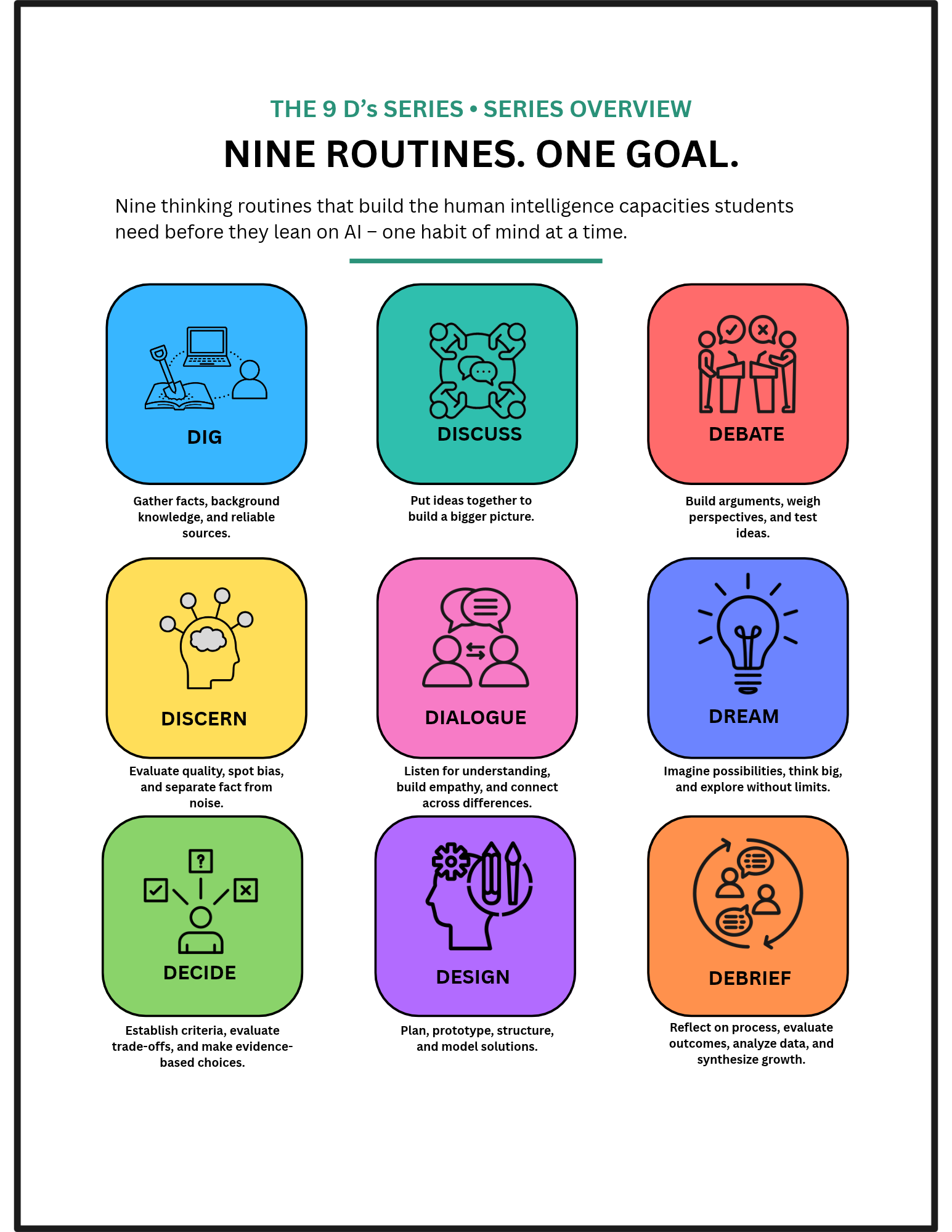
Where This Comes From: Think First and the 9 D’s
This AI Credibility Check is one step in DIG, the first routine in a series I’ve been building since August: Think First: Human Thinking Skills for the AI Era, also known as the 9 D’s.
Rather than fighting AI, each routine puts AI output beside human thinking, so students analyze the strengths and limits of both. Each routine also holds the content you already teach in math, science, social studies, ELA, and more. It doesn’t replace your curriculum. It makes students more critical consumers of it.
Try a Free Think First Lesson
Human vs. AI Thinking is a free, one-period mini-lesson. It starts one step earlier than the Monday activity above: students think for themselves first, talk it through with a partner, then check an AI answer and name what their own brains add that AI can’t. It’s ready to teach, and no student AI accounts are needed.
Get the free lesson → Human vs. AI Thinking
Try it with your class this week. Then hit reply on the welcome email and tell me what your students noticed. I look forward to and read every response.