
The activities below have been selected for their ability to capture children’s interest and encourage longer periods of open-ended play. Keep in mind that a young child’s attention span is typically about two to three minutes for each year of age. For toddlers especially, “deep engagement” is a relative term. Still, a thoughtfully chosen activity can inspire a few extra minutes of focused, absorbed play—giving children the opportunity to explore at their own pace and parents a welcome window of time to get something done.
Stickers in a Box — This is a simple and remarkably effective activity. Find a medium size box that your child can sit in. Add sheets of stickers and you’re set! Peeling, grasping, and pressing stickers onto the walls of a cardboard box builds fine motor strength and hand-eye coordination, while the cozy, contained space encourages focused, independent play. *Depending on the age of your child, this one may require adult participation with the sticker peeling.
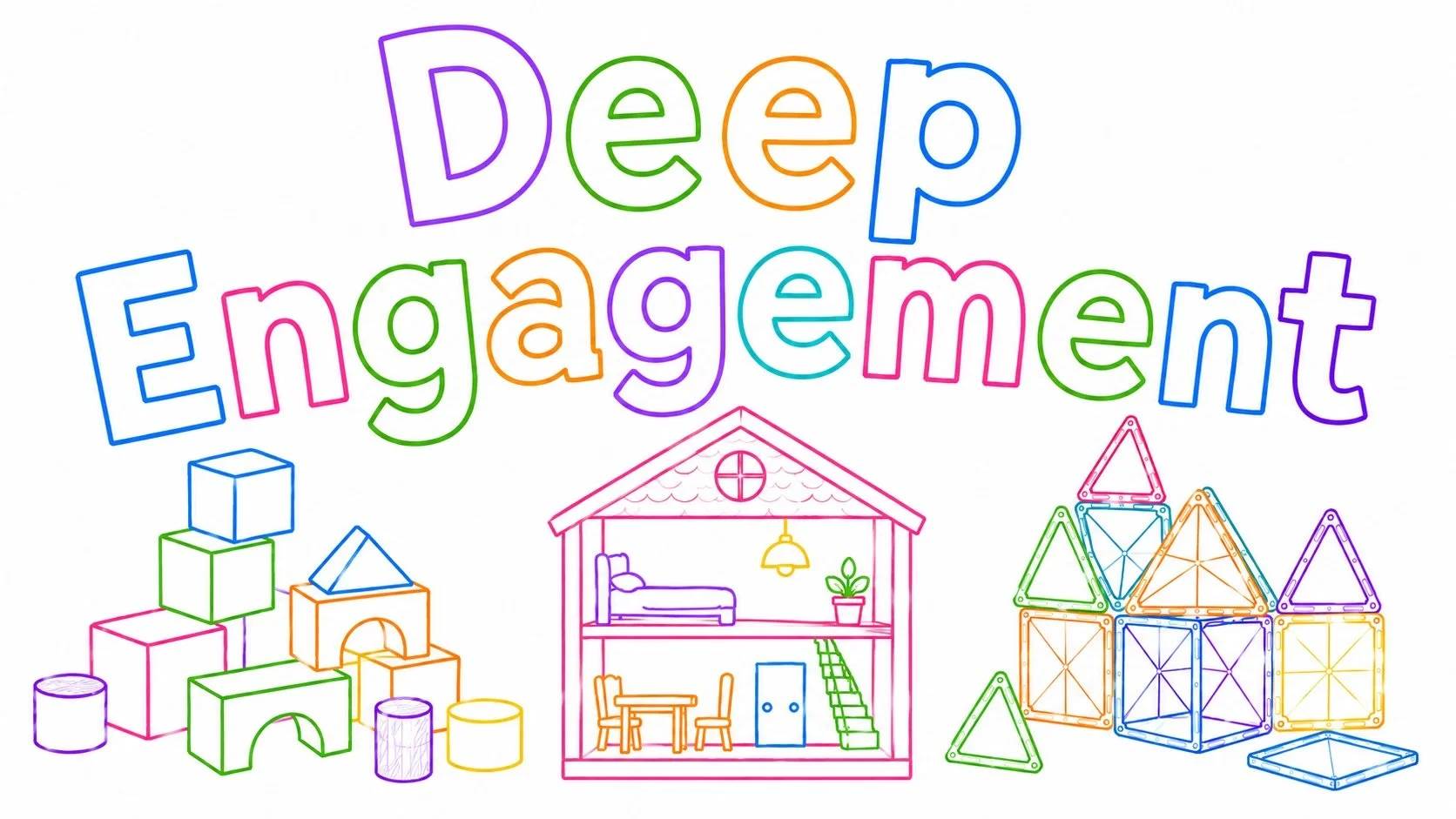
Blocks — Few toys offer as much open-ended possibility as a good set of blocks. Stacking, arranging, building, and knocking down help toddlers develop spatial awareness, balance, coordination, and early problem-solving skills. Different materials and shapes invite different kinds of exploration—from oversized cardboard bricks and classic maple wood blocks, to interlocking bricks like Lego Duplo designed for small hands. There are many kinds of open-ended block sets for children to create with.
Painting — For toddlers, painting is as much about the process as the finished product. Invite exploration with unexpected tools such as toy cars, sponges, dot painters, rollers, or chunky brushes. As children experiment with color, texture, movement, and mark-making, they strengthen fine motor skills, discover cause and effect, and experience the pleasure of creative expression without a prescribed outcome.
Make Music — Young children are naturally drawn to rhythm, repetition, and sound. Simple instruments—and everyday objects that can be tapped, shaken, or struck—encourage toddlers to experiment with cause and effect, listening, pattern, and movement. Making music also supports language development and gives children an expressive outlet that requires no words at all.
Bubbles (outdoors) — Chasing, reaching, stomping, and popping bubbles builds gross motor skills, visual tracking, and hand-eye coordination. Their unpredictable movement naturally encourages attention and anticipation.
Mail Delivery — Give your toddler a small bag of “mail” to deliver around the house. Carrying, sorting, and delivering envelopes and/or packages builds coordination and early categorization skills while giving young children a satisfying sense of purpose.
Imaginative Play — Simple play worlds—such as a pet vet clinic or ice cream shop—invite toddlers to imitate what they see in everyday life. Through pretending, children build language, practice sequencing, explore social roles, and begin to make sense of their experiences. At this age, imaginative play may begin with a single action repeated many times, but those small acts of make-believe are the foundation for increasingly complex thought and creativity.
Stickers in a Box — This remarkably simple activity invites children to create their own immersive little world. Peeling, placing, and arranging stickers refines fine motor control while encouraging planning, storytelling, and sustained creative focus.
Building — Open-ended building sets invite children to design, experiment, and solve problems through trial and error. As creations become more complex, children develop spatial reasoning, fine motor skills, persistence, and flexible thinking. To add variety to building endeavors, consider the following building tools: bristle blocks, Brio Build-It Sets, Magna Tiles, and Lego Duplo sets.
Toddler Ramp Set — Send balls and cars rolling down simple ramps made from plastic gutters or an education-grade set. Repeated experimentation introduces cause and effect, speed, gravity, and motion while encouraging early problem-solving.
Dollhouse and/or other Critter Collections — Miniature worlds invite children to create characters, relationships, and stories of their own. This kind of imaginative play builds language, social-emotional understanding, sequencing, and increasingly complex narrative thinking. There are many great options available: Hape Dollhouse, Maileg,
Cardboard Playhouse — A simple cardboard structure can become a barn, castle, animal hospital, or a world entirely of a child’s own making. Decorating and inhabiting the space encourages creativity, role play, collaboration, and the ability to develop an idea over time. Caregivers can help children build their own playhouse, or they can be purchased in a variety of pre-made options. (Barn, Castle, Halloween-Themed, Animal Hospital, or Blank.)
Sensory Kits - Thoughtfully designed sensory materials invite children to scoop, pour, sort, shape, and explore through touch. This hands-on play supports fine motor development, concentration, problem-solving, and imaginative thinking.
Loose Parts
A collection of open-ended materials—such as stones, wooden pieces, rings, and natural objects—invites children to arrange, combine, sort, and transform them in endlessly different ways. This self-directed play builds creativity, spatial reasoning, problem-solving, and the ability to develop and pursue ideas of their own.
Painting
At this age, painting becomes increasingly intentional as children experiment with color, shape, pattern, and representation. Open-ended painting strengthens fine motor control while encouraging creative expression, planning, and the confidence to bring their own ideas to life.
Building & Construction
More complex building materials invite children to design, test, and revise their ideas. As they turn plans into structures, children strengthen spatial reasoning, problem-solving, persistence, and the ability to learn through trial and error.
Loose Parts
Open-ended collections of natural and manufactured materials can become sculptures, inventions, patterns, or entirely imagined creations. With no prescribed outcome, loose parts encourage flexible thinking, creativity, planning, and the confidence to pursue ideas of one’s own.
Cardboard Construction
With cardboard, tape, scissors, and a few simple tools, children can create everything from vehicles and robots to houses and arcade games. Working at this scale develops planning, spatial reasoning, problem-solving, and the persistence to bring an ambitious idea to life.
Art Studio
A rich selection of paint, drawing materials, clay, collage supplies, and mixed media invites children to develop ideas and explore them over time. Open-ended art strengthens creative thinking, fine motor control, decision-making, and confidence in personal expression.
Miniature Worlds
Figures, animals, blocks, and natural materials invite children to build detailed environments and bring them to life through story. This immersive play develops language, narrative thinking, spatial awareness, and the ability to organize increasingly complex ideas.
Imaginative Play
Restaurants, shops, theaters, animal hospitals, and other invented worlds allow children to take on roles and develop stories together. Through pretend play, children build communication, collaboration, empathy, and a deeper understanding of the world around them.
Tinkering & Invention
Open-ended tools, mechanisms, and materials invite children to investigate how things work—and imagine how they might work differently. Tinkering develops curiosity, engineering thinking, persistence, and the confidence to experiment without knowing the answer in advance.
Sewing & Fiber Arts
Sewing, weaving, braiding, and other fiber arts combine creativity with the satisfaction of mastering a new skill. These absorbing, hands-on activities strengthen fine motor control, concentration, sequencing, patience, and perseverance.
Advanced Building & Engineering
Complex construction systems invite children to design, test, troubleshoot, and refine increasingly ambitious creations. This iterative process develops spatial reasoning, engineering thinking, persistence, and the ability to turn abstract ideas into working solutions.
Tinkering & Invention
Real tools, mechanical parts, circuits, and open-ended materials give children the freedom to investigate, experiment, and invent. Tinkering builds technical confidence, creative problem-solving, and the willingness to learn through trial, error, and revision.
Art Studio
A well-stocked studio invites children to explore drawing, painting, printmaking, sculpture, and mixed media with growing independence. As they develop their own ideas and techniques, children strengthen creative thinking, decision-making, self-expression, and the ability to sustain a project over time.
Sewing & Fiber Arts
Sewing, embroidery, weaving, knitting, and other fiber arts offer the satisfying challenge of building skill through practice. These activities strengthen fine motor precision, concentration, patience, sequencing, and the ability to follow a complex process from beginning to end.
Woodworking & Making
Working with wood and age-appropriate tools gives children the opportunity to measure, plan, build, and create something tangible. The process develops spatial reasoning, precision, practical problem-solving, persistence, and confidence in their own capabilities.
Stop-Motion & Filmmaking
Creating a film requires children to combine storytelling, visual design, sequencing, and technology. Planning scenes, solving production challenges, and editing a finished piece develops communication, collaboration, patience, and complex project-management skills.
Miniature Worlds & Model Making
Designing dioramas, models, and detailed miniature environments combines imagination with careful construction. This absorbing work develops spatial reasoning, planning, fine motor precision, storytelling, and attention to detail.
Coding & Robotics
Open-ended coding and robotics projects invite children to create, test, debug, and improve their ideas. Along the way, they develop logical thinking, persistence, systems thinking, and the understanding that mistakes are an essential part of solving complex problems.
Cardboard Engineering
Cardboard, cutting tools, fasteners, and tape can become working games, machines, furniture, costumes, or large-scale inventions. Designing and constructing these projects strengthens measurement, spatial reasoning, resourcefulness, and the ability to adapt a plan as new challenges arise.
Independent Creative Projects
Whether writing a book, designing a board game, creating a comic, or launching an elaborate make-believe business, self-directed projects give children ownership of both the process and the outcome. They build planning, sustained attention, creative confidence, and the ability to carry an idea from inspiration to completion.